 |
 |
 |
 |
 |
 |
 |
Generation Three
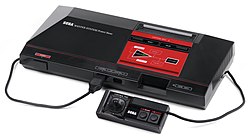
Sega Master System
In the early 1980s, Sega Enterprises, Inc., then a subsidiary of the American conglomerate Gulf and Western, was one of the largest arcade game manufacturers active in the United States, with company revenues of $214 million by mid-1982. A downturn in the arcade business starting in 1982 negatively impacted the company, leading Gulf and Western to sell the North American manufacturing and licensing of its arcade games to Bally Manufacturing. The company retained its Japanese subsidiary, Sega Enterprises, Ltd., as well as Sega's North American research and development division. With its arcade business in decline, Gulf and Western executives turned to Sega Enterprises, Ltd.'s president, Hayao Nakayama, for advice on how to proceed. Nakayama advocated that the company leverage its hardware expertise gained through years working in the arcade industry to move into the home console market in Japan, which was in its infancy at the time. Nakayama received permission to proceed with this project, leading to the release of Sega's first home video game system, the SG-1000.
The SG-1000 was first released in Japan on July 15, 1983, at a price of JP¥15,000.[16] It was launched on the same day that Nintendo released the Family Computer (Famicom) in Japan.
The SG-1000 was first released in Japan on July 15, 1983, at a price of JP¥15,000. It was launched on the same day that Nintendo released the Family Computer (Famicom) in Japan. Shortly after the launch of the SG-1000, Gulf and Western began to divest itself of its non-core businesses after the death of company founder, Charles Bluhdorn, so Nakayama and former Sega CEO David Rosen arranged a management buyout of the Japanese subsidiary in 1984 with financial backing from CSK Corporation, a prominent Japanese software company. Nakayama was then installed as CEO of the new Sega Enterprises, Ltd. Following the buyout, Sega released another console, the SG-1000 II, for ¥15,000. It featured a few hardware tweaks from the original model, including detachable controllers. The SG-1000 II did not sell well, however, leading to Sega's decision to continue work on the video game hardware used for the system. This resulted in the release of the Sega Mark III in Japan in 1985
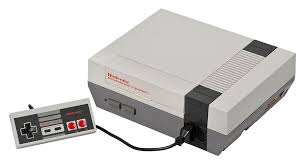
Nintendo Entertainment System
Following a series of arcade game successes in the early 1980s, Nintendo made plans to create a cartridge-based console called the Famicom, which is short for Family Computer. Masayuki Uemura designed the system. Original plans called for an advanced 16-bit system which would function as a full-fledged computer with a keyboard and floppy disk drive, but Nintendo president Hiroshi Yamauchi rejected this and instead decided to go for a cheaper, more conventional cartridge-based game console as he felt that features such as keyboards and disks were intimidating to non-technophiles. A test model was constructed in October 1982 to verify the functionality of the hardware, after which work began on programming tools. Because 65xx CPUs had not been manufactured or sold in Japan up to that time, no cross-development software was available and it had to be produced from scratch. Early Famicom games were written on a system that ran on an NEC PC-8001 computer and LEDs on a grid were used with a digitizer to design graphics as no software design tools for this purpose existed at that time.
 |
|